By Scot Danforth
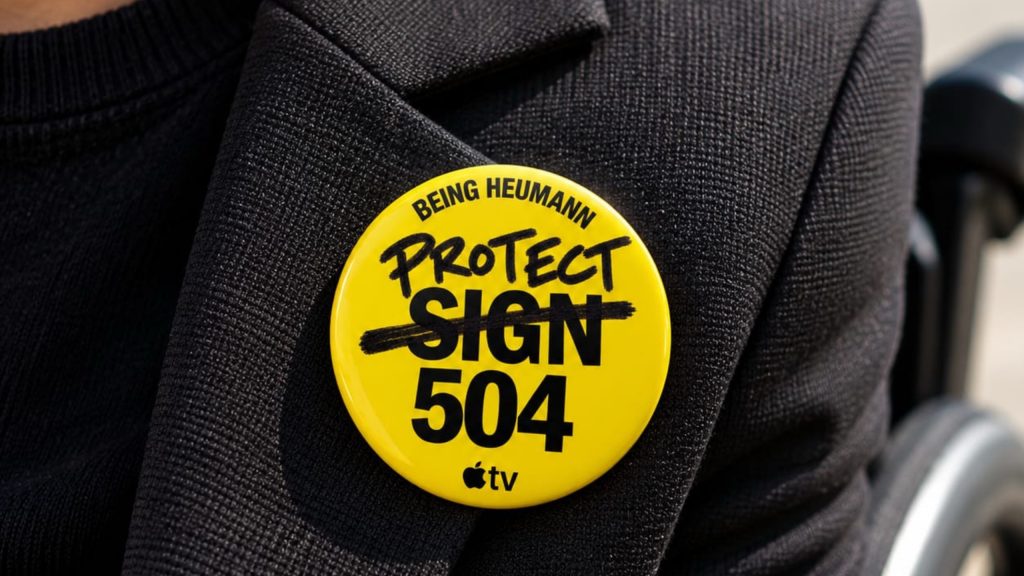
A single line of the Rehabilitation Act of 1973 called Section 504 outlawed all forms of discrimination against disabled people in any entity or activity receiving Uncle Sam’s dollars. Universities, hospitals, schools, and all state or local governments. Most acts of disability prejudice and exclusion became illegal.
But Section 504 could only be enacted when the Department of Health, Education, and Welfare (HEW) approved the official regulations. Presidents Nixon, Ford, and Carter didn’t sign off. The first disability civil rights law in the United States sat dormant for over three and a half years.
President Carter and his new HEW secretary Joseph Califano inherited a dysfunctional HEW. The agency had a backlog of three to four thousand Title IX complaints of sex discrimination in public schools and higher education. Many HEW staff members tasked with enforcing civil rights statutes didn’t take discrimination seriously.
When Califano announced yet another round of 504 guidelines review, activists at the Berkeley Center for Independent Living (CIL) and the DC-based American Coalition of Citizens with Disabilities (ACCD) leaped into action. ACCD leaders Eunice Fiorito and Frank Bowe warned that Califano was creating what Bowe called “loopholes, waivers, and exemptions” that significantly weakened the law.
The ACCD warned President Carter: Sign the regulations unchanged by April 4, 1977 or protests will break out across the country. Carter and Califano were not worried. What could a bunch of weak people in wheelchairs do?
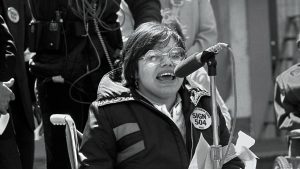
Of the ten urban protests, only San Francisco lasted beyond a few days. Leaders Judy Heumann and Kitty Cone of the Berkeley CIL were, in the words of journalist Evan White, “very strong women you don’t mess with.” Heumann had experience and knowledge about Washington politics, how to influence elected representatives and agency heads. Cone was a master of the politics of the street, the mass mobilization of constituencies of opposition and protest.
A graduate of Long Island University, Heumann became an activist when the New York Board of Education denied her a teaching license due to her disability. She won a high profile court case against the Board that thrust the nervous young woman into the limelight. She debated a federal Department of Education administrator on the popular The Today Show, a national television program hosted by Barbara Walters and Hugh Downs.
Heumann founded Disabled in Action (DIA), a New York-based activist group. When President Nixon vetoed early versions of the Rehabilitation Act, Heumann led the DIA in a series of dramatic street protests, blocking traffic on busy Madison Avenue in front of Nixon’s reelection campaign headquarters.
Cone attended the University of Illinois as part of the well-known campus Disability Center rehabilitation program. She honed her activist chops as a student leader in the civil rights and anti-war movements. Then she worked as an organizer for the Socialist Worker’s Party in Chicago, Atlanta, Tampa, and Washington, DC. By the time she arrived in Berkeley in 1972, she was an experienced political operative.
When her wheelchair broke, a friend suggested she see the top notch repair crew at the Berkeley CIL. With years of experience in leftist activism, this was her first introduction to disability rights work. She asked director Ed Roberts for a job, telling him that she was a political organizer. Ed immediately assigned her to work with Hale Zukas, the CIL’s mastermind behind accessibility successes like curb cuts and the BART light rail system.
In an era when women rarely held high office or ran corporations, Heumann and Cone were a powerful leadership duo. Well-organized, knowledgeable, and relentless, they spent weeks creating an effective protest team. They recruited a capable squad of lieutenants that included Mary Lou Breslin, Mary Jane Owen, Pat Wright, Ray Uzeta, Karen Parker, Joni Breves, and Jim Peachum. These were not greenhorns. This was a seasoned, savvy group of disability rights veterans, an all-star team of activists united for political fight of their lives.
The CIL-based group built a diverse coalition of Bay Area organizations, including trade unions, faith groups, the LGBTQ community, and African American civil rights leaders. Very intentionally, they united the often disparate disability groups – the physically disabled, blind, deaf, and people with developmental disabilities – into a single political voice.
On April 5, 1977, when Judy Heumann led over one hundred protesters into the federal building to begin the longest sit-in protest in American history, it was a spontaneous act. The participants entered the fourth floor HEW offices not knowing if they would stay or how long they would be there. Little did they know that Heumann, Cone, and their leadership committee had spent weeks preparing to win this political battle.

About the author
Scot Danforth is Jack H. and Paula Hassinger Chair in Education, Professor of Disability Studies, Chapman University, and author of An Independent Man: Ed Roberts and the Fight for Disability Rights.