By Scot Danforth
Like her longtime activism collaborator Ed Roberts, Judy Heumann was a polio survivor. She grew up in a close-knit Jewish family and supportive community in Brooklyn. She was segregated in public school special education programs until high school. But even when included in general classrooms, she felt isolated.
As chronicled in the fantastic documentary Crip Camp, Heumann thrived in joyful, hippy summer camps for kids with disabilities. There she learned how to create a unique social space where disabled people felt accepted.
As a student Long Island University, she was the first wheelchair user to live in a dormitory. She helped develop the campus accessibility program and graduated with honors in 1970.
Her career as a radical activist began when she was denied a New York state teaching license. If she could walk upright, the physician conducting the required medical examination would have passed her. The doctor told her to go home and come back using crutches. Heumann refused to pretend that she didn’t use a wheelchair. The doctor claimed that Heumann would be unable to help students evacuate a school building in the case of an emergency. She was, to Heumann’s ire, a fire hazard.
The New York Times published a supportive editorial, “License Miss Heumann.” “Sitting in her wheelchair,” the editors wrote, “she can show students, handicapped or normal, that the desire to teach and learn is the first educational step.”
When Heumann appeared on the national morning television program The Today Show, she instantly became the highest profile disabled person in the country. Her court case against the state education board was decided in her favor by federal judge Contance Baker Motley, an African American woman with a history of arguing NAACP school desegregation cases.
For months, Heumann did interviews for magazines, radio shows, and television. Public speaking didn’t come naturally to her. As she did later when confronting Health, Education, and Welfare bureaucrat Gene Eidenberg in the 504 congressional hearings, she broke down in tears. But her unrelenting passion for the disability justice cause carried her forward even when her nerves were rattled.
On the west coast, John Hessler and Hale Zukas organized the Berkeley Center for Independent Living (CIL). On the eastern seaboard, Judy Heumann started Disabled in Action (DIA). Within a year, Heumann’s cross-disability alliance grew to fifteen hundred members from New York to Washington, D.C.
Eunice Fiorito, a blind woman who ran the New York City Mayor’s Office for People with Disabilities, spread the word among activists that a single line in the Rehabilitation Act that President Nixon twice vetoed would open doors for disabled people across the country.
In October 1972, Heumann rallied Disabled in Action to fight Nixon. They staged dramatic public protests, taking to the streets in the nonviolent but provocative civil disobedience style of the civil rights movement. The unseen people traditionally assumed to be passive and cheerful objects of charity exploded with rage and passion.
DIA teamed up with Vietnam Vets leader Bobby Muller to block all Times Square traffic for twenty minutes. Muller shouted at frustrated automobile drivers through a bullhorn: “It may be a matter of you being late for dinner, but maybe it’s a matter of life and death for us.”
In May 1973, DIA collaborated with the American Council of the Blind to stage a Washington, DC demonstration targeting an ironically-titled, federal “Hire the Handicapped” event. Three thousand people listened politely to President Nixon’s daughter Julie Eisenhower giving an upbeat speech at the Washington Hilton. Heumann’s team of activists interrupted the presentation, shouting Eisenhower down. They hollered, “Why did the president veto the Rehabilitation Act? Why doesn’t Nixon want to employ disabled people?”
In DC, Heumann met two leaders from the Berkeley CIL, Dick Santos and Larry Biscamp. They told her about the CIL and their work. She found the independent living concept intriguing. The DIA focused on changing government policies. The CIL mixed activism and useful assistance in a way that directly impacted individuals in the community. Heumann came away from the conversation wanting to know more about the CIL and independent living.
In 1973, at the invitation of Ed Roberts, Judy Heumann joined him in Berkeley as a CIL staff member and University of California, Berkeley graduate student. This began a Roberts-Heumann activism partnership that lasted for decades. In 1983, the daring duo founded of the World Institute on Disability with their colleague Joan Leon.
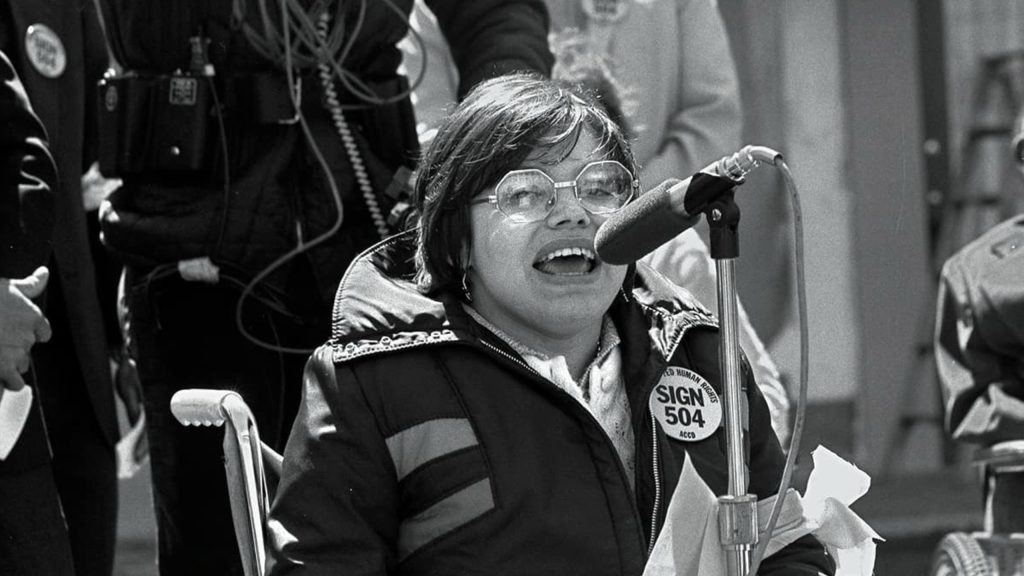
In April, 1977, the call came from Fiorito and Frank Bowe of the Washington, DC-based American Coalition of Citizens with Disabilities (ACCD) to join a national action against President Carter and Health, Education, and Welfare Secretary Joseph Califano’s refusal to approve the Section 504 final regulations. Working from the Berkeley CIL, reaching out to LGBTQ, civil rights, and disability communities across the Bay Area, they organized the San Francisco sit-in that changed the landscape of American disability politics forever.
Later, Heumann rose to prominent leadership roles. Under President Clinton, she was Assistant Secretary of the Office of Special Education and Rehabilitation Services. She served as Senior Advisor on Disability and Development for the World Bank. She was a Special Advisor for International Disability Rights at the U.S. Department of State in the Obama administration.

About the author
Scot Danforth is Jack H. and Paula Hassinger Chair in Education, Professor of Disability Studies, Chapman University, and author of An Independent Man: Ed Roberts and the Fight for Disability Rights.